Atma Curatorial Notes
Atma Curatorial Notes

Atma was part of a group exhibition entitled “Here After” which highlighted various traditional perspectives on the concept of the afterlife. Atma was dedicated to the artist’s dear friend who had recently died.
On the word Atma:
Atma is Sanskrit word which refers to essence, breath, soul, or self and is taken from Ātman, which in Indian philosophy means one’s innermost essence.
Philosophical schools such as Advaita (non-dualism) see the Atma or Atman as the "spirit" within each living entity as being one with Brahman – the Source or ground of all being.
Yajnavalkya (c. 9th cenutry BCE), in the Brihadaranyaka Upanishad, uses the term Atman to indicate that in which everything exists and which permeates everything. This is similar to the Christian concept of living in Christ, “in Him we live and move and have our being” from Acts 17:28 in the Christian New Testament.
In Hindu philosophy, especially in the Vedanta school of Hinduism, Ātman is the first principle, the True Self of an individual beyond identification with phenomena, the essence of an individual. In order to attain freedom (liberation), a human being must acquire self-knowledge (atma jnana), which is not ego knowledge, but rather knowledgeable of one's True Self (Atma or Ātman), the transcendent Self, Brahman (or Paramatman):
"If Atman is Brahman in a pot (or body), then one need merely break the pot to fully realize the primordial unity of the individual soul with the plentitude of Being that was the Absolute.”[1]
The Rumi poem below underlines this sense of finding union with the source which is also the central theme of Eastern Orthodox Christianity also known as theosis, that through union with God one finds union with ALL, including our loved ones, for eternity...
Out beyond ideas of wrongdoing and rightdoing
there is a field. I'll meet you there.
When the soul lies down in that grass,
the world is too full to talk about.
Ideas, language, even the phrase "each other"
doesn't make any sense.
Translation of Talal al-Din Rumi by Coleman Bark (2)
Notes:
1. David Gordon White, (1996). The Alchemical Body: Siddha Traditions in Medieval India. Chicago: University of Chicago Press; 18. Quoted online in InfoRefuge "Patanjali’s Yoga Darsana – The Hatha Yoga Tradition." NOTE: Similar identification also made in the Hathayogapradipika (4.50)
2.Jalal al-Din Rumi, “Out beyond ideas of wrongdoing and rightdoing,” trans. Coleman Barks, in The Essential Rumi (San Francisco: HarperSanFrancisco, 1995), 36.

On the initial symbolism of the work, including the significance of the work being built into the gallery’s threshold / doorway.
In Atma, we see our body transfigured and encircled or merged with the singular purity of the light and atmosphere that sustains us (and all living things), which we live in and breath in daily as our very breath. This gift of life we receive without merit or achievement, it’s a gratuitous gift, as Ruskin said, “the sky is for all.”(1)
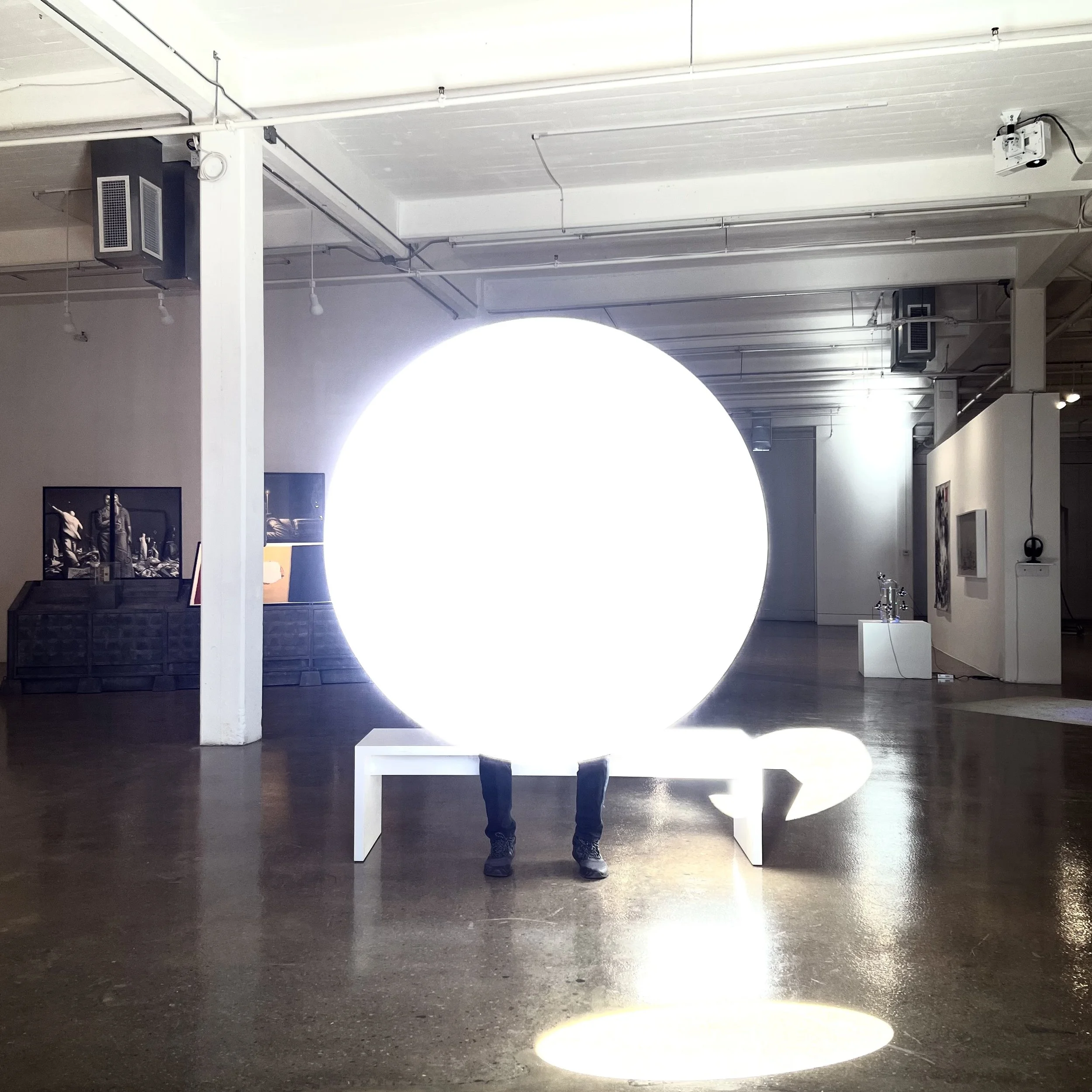
This calls back to the ancient story of the Transfiguration of Christ (seen below). We see ourselves and this light merge together, held within this threshold or opening, becoming an archetypal symbol of portal between heaven and earth, between the mundane and the transcendent, a place of transition from a constricted awareness to a widened one.
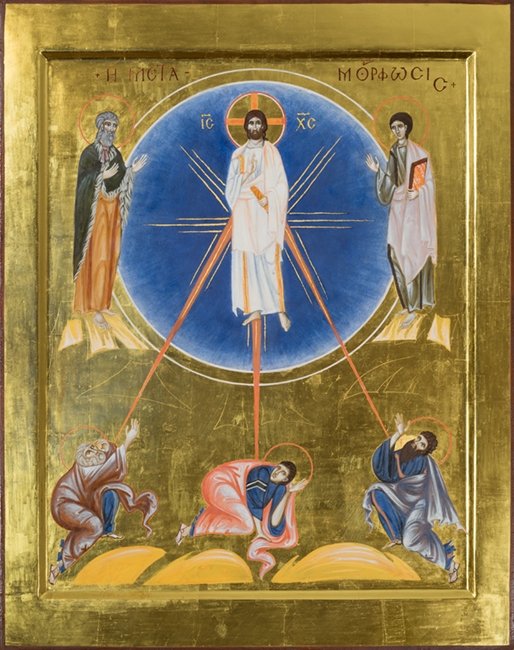
Orthodox Icon of the Transfiguration of Christ. by Philip Davydov. 50 X 40 cm (20 X 16 inches), 2017
Note the blue circle of light consuming Christ and beaming out towards the disciples.
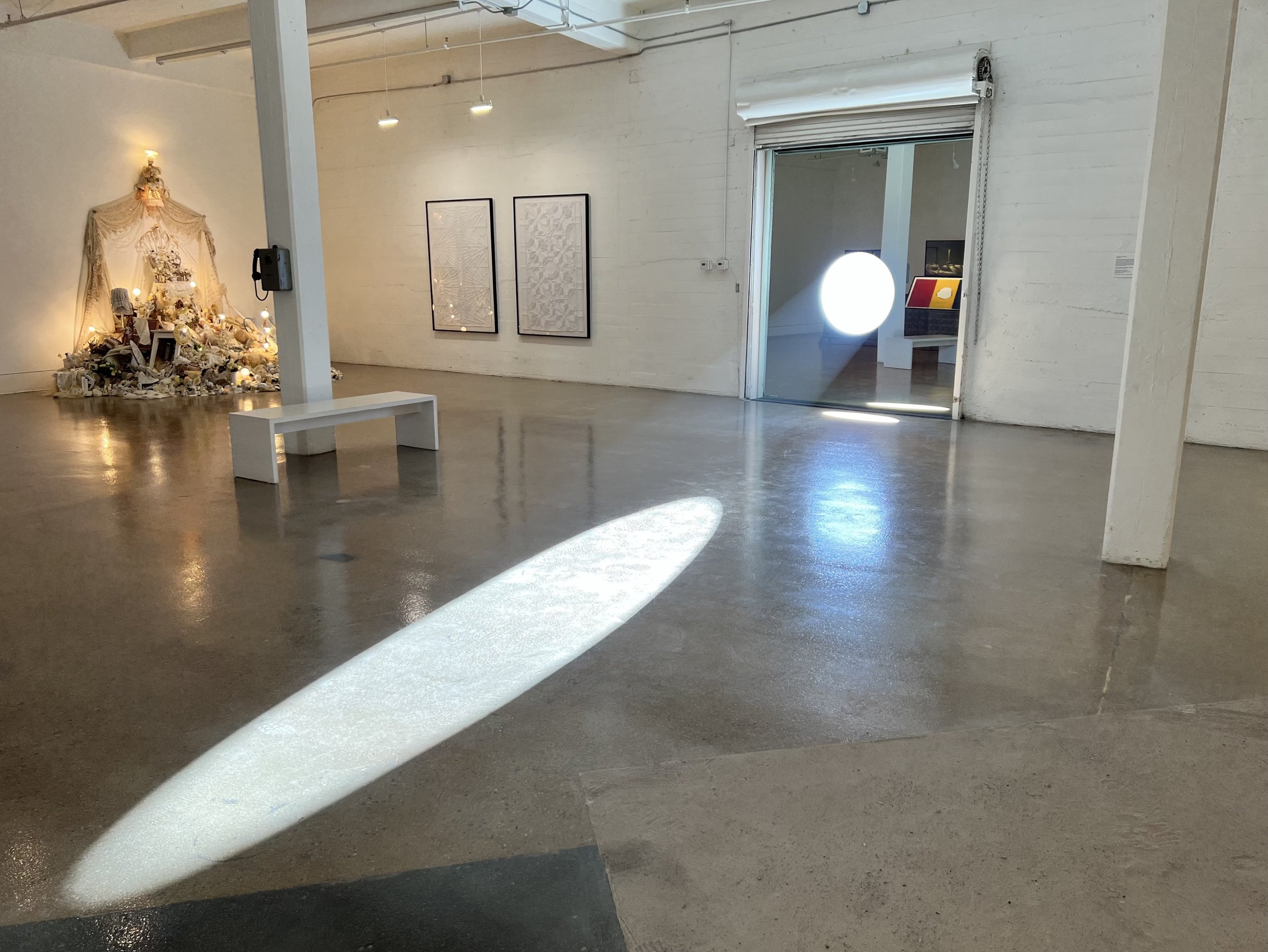
The work then becomes an alchemical apparatus (2) bringing down the immateriality of the light and presence of the sky and allowing it to become physicalized, merging it with our bodies. So that which seems beyond comes near, where we not only sit face to face with it, but we become engulfed by it, revealing our own transfiguration— reminding us of the light or glory of our truest self, our deepest incorruptible essence, which is, like the sky, the the breath of life, light from light.
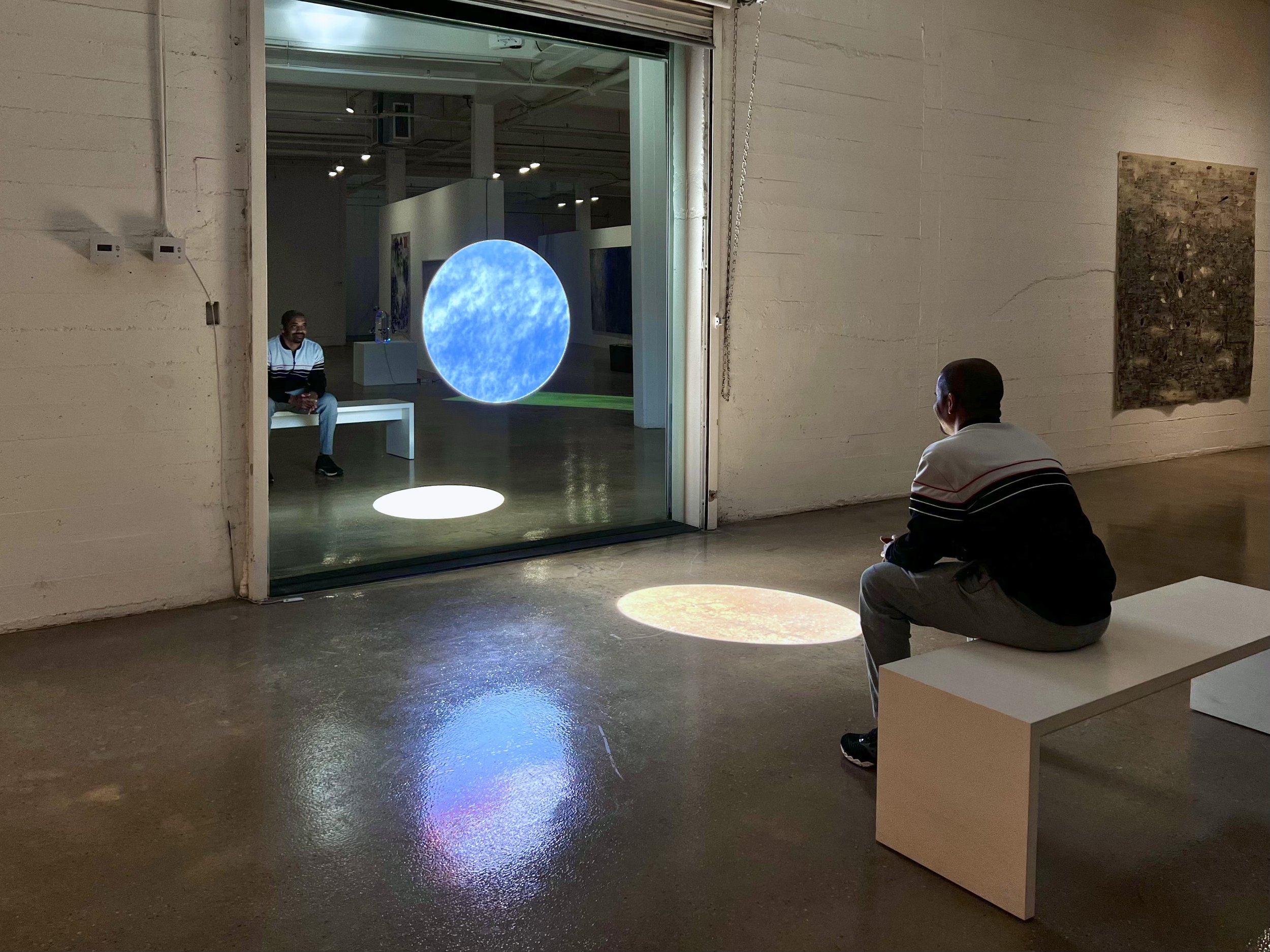
Here, the sky comes down as if to look into us as much or more than we are here looking into it. It enwraps our image with a bright fullness that symbolizes our dependence on it for our life, that we live in and move and have our being in it.

Like Rumi suggests above, the “place where we meet” is not only a hope projected into the hereafter, but an encounter that we can know even now. We meet there not by staring at one another as objects, but by turning together toward what is deeper than our self-images, looking outward and inward in the same movement, and finding ourselves in a shared field of belonging and beholding. It is a place of rest and re-membering: a return to the deep-bodied knowing that we come from the same givenness, live within it together, and are sustained by it with every breath. From that vantage, the question of “where else could we be?” begins to soften, along with the fear that this givenness or love could ever be lost.
In this way, the work becomes a contemplative listening space—an opportunity to sense this not as an idea, but as a lived experience. That response arose naturally for many visitors rising the work within the gallery and required no instruction or text, as seen in the image below.

Notes:
1- John Ruskin, Modern Painters, vol. 1 (New York: John Wiley & Son, 1866), 197.
2- Re: alchemical apparatus, most of alchemy has to do with this idea of incarnation, spirit and matter becoming one, which you can see here in this alchemical text by Solomon Trismosin, The Splendor Solis, (The Splendor of the Sun) Plate 1, Arma Artis, (or The Arms of Art) (1582 in the British Museum, pictured below). The sun, the light or spirit descends downwards, fire moving through the mysterious dark moon-starry waters into the physicality of the shield (which happens to be tilted at 45º in the picture, and reflecting the sky). So the sky / sun / light / spirit are descending down and coming into physical form on earth. And, coincidentally, 45 is the Hebrew word for Adam, אדם, meaning “humanity” or “earth”. In Atma, we are also offered a physical face to face encounter with the sky via an angled 45 degree mirror.

-------------------------------
On the significance of Glass, Mirror, Frame, Sun:
Glass
Glass has been used by humans for more than four millennia, with early evidence in Mesopotamia and Egypt. Medieval alchemists adopted it as a primary emblem of their work because it is both vessel and threshold: a transparent container in which transformation can occur while still being seen. Its very making carries this logic—sand brought to heat, becoming liquid, cooling into an amorphous solid, and capable of returning again to a molten state.
In alchemical symbolism, glass is often linked with salt and ash: distilled residues of physical and inner processes—calcination, sublimation, purification—where what is coarse is refined and what is hidden is clarified. In this sense, glass becomes a material metaphor for transmutation: not merely change, but a revealing.
In Atma, glass functions in this register as a medium of clarity, insight, and vision. It is the quiet condition that allows light to enter, be framed, and become encounter. It is also the signature material of modern seeing: eyeglasses, microscopes, telescopes, phones, screens, windows, and architecture. Even global communication travels through glass fiber. Glass is how we look out—and, increasingly, how the world reaches us.

Mirror
Mirrors predate glass and metal. Before anything was polished or manufactured, reflection already existed in puddles, ponds, and still lakes, surfaces that returned a face to itself. Across cultures, such reflections were often felt to reveal more than appearance. Mirrors were thought to reflect a person’s essence, inner nature, or soul.
In accent Egypt, mirrors were associated with the essential nature of a thing. The Egyptian hieroglyph for life: the ankh, was also the word for life and mirror. [1] It suggested a relationship between reflection, vitality, and what animates a being. The mirror, in this sense, was not simply a tool of representation, but a sign of life’s luminous core.
The mirror also became an image of the solar disk: the source of light understood as carrying life’s sustaining power. This symbolism appears vividly in Shinto practice, where the circular mirror is a potent presence within the shrine:
"The circular mirror of Shinto is a potent symbol. One often sees it when visiting shrines, where it stands on the altar as representative of the kami (a divine being) and sometimes functions as the ‘spirit-body’ (goshintai) of the kami. The idea is that the spirit enters into the object to take physical form." [2]
(In Atma, the sky’s light is likewise gathered by the mirror and made physically present in the room—less as an object to look at than as an encounter to enter.)
Here, the mirror is understood as an interface—an object that joins realms, allowing what is unseen to be encountered through a visible form. [2] Japanese mythology speaks of this most directly in the story of Amaterasu, the sun goddess, whose name can be read as “heaven-shining one.” [2] The story goes that Amaterasu gave a circular mirror to her grandson, Ninigi, when he descended to earth, believing it held her essence and could be gazed upon to truly see the “Heaven Shining one” anytime. [2]
The ancient Chinese believed the human soul to also be a shining disc, a connotation that carried over to the circular mirror.
In Atma, the mirror participates in this long symbolic lineage. It does not function as vanity or spectacle, but as a threshold surface: a place where light becomes bodily, where the sky is gathered and made intimate, and where the viewer can experience reflection not as self-judgment, but as a quiet form of transfiguring encounter.

Frame
In Atma, we encounter a void or negative space: a 33-inch circular opening that holds a particular presence within it. Yet what it reveals is never contained by its own border. The frame is only the beginning of the encounter, much like the physical boundary of a human body is only the beginning of who a person truly is. There is an endlessness to the work: the farther we look out, the farther we find ourselves looking in.
A parallel image of an opening “filled” with presence appears in the Hebrew scriptures. In the tabernacle and later the temple, the innermost chamber—the Holy of Holies—was described as a perfect cube: a sealed, windowless space of total darkness. Within it stood the Ark of the Covenant. Upon it was the gold cover known as the mercy seat with two angelic statues called cherubim, positioned facing one another. Their bodies were bowed, their faces turned downward, and their wings stretched out toward the center, forming a small, charged space between them. That darkness and the space between the outstretched wings, was understood as the locus of divine meeting and presence.

Sun
Atma harnesses the sun and reveals it in a way that can be physically encountered within the gallery. The light is gathered and focused so it moves through the space—illuminating wall, floor, and body—unfolding over time as a living event rather than a fixed image. In many spiritual traditions there are accounts of a radiance often called “glory” shining upon the face of the faithful; here, that association is felt not as an idea, but as an affective, bodily experience of being touched by light.
This is also why the language of near-death accounts can feel unexpectedly close to what happens at the threshold. Such accounts often describe a brightness that is not merely observed at a distance, but met: a light that feels intimate, encompassing, and strangely personal—less like looking at illumination and more like being held within it. On clear days, from late morning into the afternoon, anyone who approaches the work receives a direct beam of sunlight to the face—an encounter with the sun’s life-giving power made immediate through the architecture of the piece. The work doesn’t mimic a near-death experience, but it shares a recognizable contour: the way overwhelming radiance can shift perception from thinking about light to being in light.
In this way, the work does not remain confined to the threshold. It inhabits the gallery itself, and the visitor experiences it not only visually, but physically—through warmth, radiance, and the felt presence of light moving through time.

Notes:
1. The Book of Symbols, Reflections on Archetypal Images, p. 588-592
2. https://www.greenshinto.com/2012/02/18/the-circular-mirror-shinto-symbol/
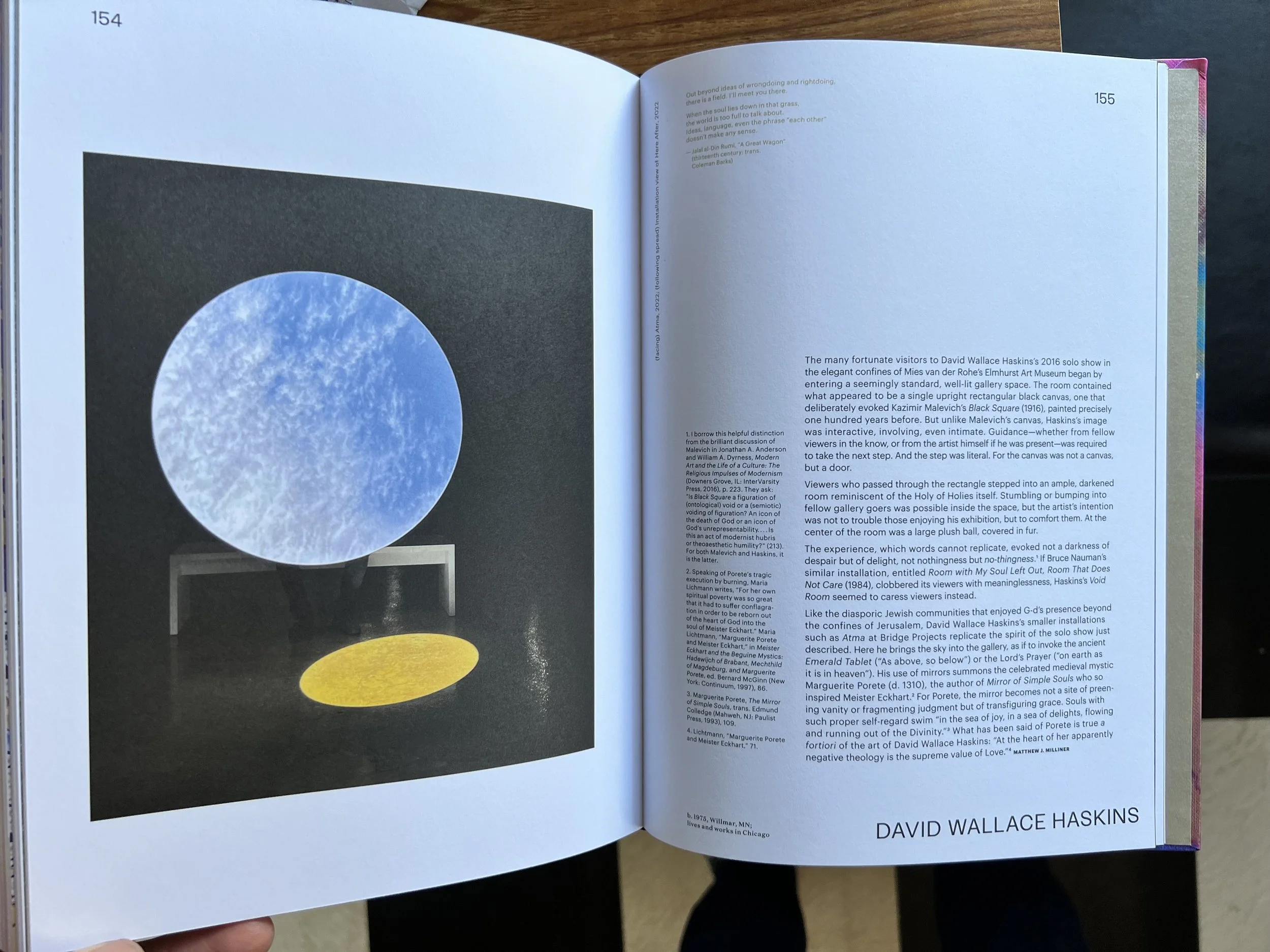
Here / After Catalogue Essay
by Dr. Matthew J. Milliner
The many fortunate visitors to David Wallace Haskins's 2016 solo show in the elegant confines of Mies van der Rohe's Elmhurst Art Museum began by entering a seemingly standard, well-lit gallery space. The room contained what appeared to be a single upright rectangular black canvas, one that deliberately evoked Kazimir Malevich's Black Square (1916), painted precisely one hundred years before. But unlike Malevich's canvas, Haskins's image was interactive, involving, even intimate. Guidance-whether from fellow viewers in the know, or from the artist himself if he was present-was required to take the next step. And the step was literal. For the canvas was not a canvas, but a door.
Viewers who passed through the rectangle stepped into an ample, darkened room reminiscent of the Holy of Holies itself. Stumbling or bumping into fellow gallery goers was possible inside the space, but the artist's intention was not to trouble those enjoying his exhibition, but to comfort them. At the center of the room was a large plush ball, covered in fur.
The experience, which words cannot replicate, evoked not a darkness of despair but of delight, not nothingness but no-thingness.' If Bruce Nauman's similar installation, entitled Room with My Soul Left Out, Room That Does Not Care (1984), clobbered its viewers with meaninglessness, Haskins's Void Room seemed to caress viewers instead.
Like the diasporic Jewish communities that enjoyed G-d's presence beyond the confines of Jerusalem, David Wallace Haskins's smaller installations such as Atma at Bridge Projects replicate the spirit of the solo show just described. Here he brings the sky into the gallery, as if to invoke the ancient Emerald Tablet ("As above, so below") or the Lord's Prayer ("on earth as it is in heaven"). His use of mirrors summons the celebrated medieval mystic Marguerite Porete (d. 1310), the author of Mirror of Simple Souls who so inspired Meister Eckhart.* For Porete, the mirror becomes not a site of preening vanity or fragmenting judgment but of transfiguring grace. Souls with such proper self-regard swim "in the sea of joy, in a sea of delights, flowing and running out of the Divinity."*
What has been said of Porete is true a fortiori of the art of David Wallace Haskins: "At the heart of her apparently negative theology is the supreme value of Love."*
MATTHEW J. MILINER
Notes:
1. I borrow this helpful distinction from the brilliant discussion of Malevich in Jonathan A. Anderson and William A. Dyness, Modern wand te Live or a culture. the Religious Impulses of Modernism (Downers Grove, IL: Inter Varsity Press, 2016), p. 223. They ask: *Is Black Square a figuration of (ontological) void or a (semiotic) oiding of figuration? An icon of the death of God or an icon of God's unrepresentability....ls this an act of modernist hubris or theoaesthetic humility?* (213). For both Malevich and Haskins, it is the latter.
2. Speaking of Porete's tragic execution by burning, Maria Lichmann writes, "For her own spiritual poverty was so great that it had to suffer conflagra. tion in order to be reborn out of the heart of God into the soul of Meister Eckhart.* Maria Uchtmann, *Marguerite Porete and Meister Eckhart, in Meister Eckhart and the Beguine Mystics: Hadewijch of Brabant, Mechthild of Magdeburg, and Marguerite Porete, ed. Bernard McGinn (New York: Continuum, 1997), 86.
3. Marguerite Porete, The Mirror of Simple Souls, trans. Edmund Colledge (Mah Press, 1993), 109. weh, NJ: Paulist
4. Lichtmann, *Morguerite Porete and Meister Eckhart, 71.